
| Facility Information |
| User Guide |
| PAC |
| Beam Time Operation |
| RIBF User Group |
| Collaboration |
| Seminars |
| Links |
| Archives |
|


BigRIPS
 |
 |
 |
 |
 |
 |
||||
| Configuration, Devices, Optics | Secondary beam intensity expected |
Technical Information - Secondary beam intensity expected
- The LISE++ input files for BigRIPS (2024/Apr./1)
- Production cross sections for the in-flight-fission 238U+Be at 345 A MeV (2024/Apr./1)
- Production cross sections for the 124Xe+Be reaction at 345 A MeV (2019/Jul./5)
- Production cross sections for the 78Kr+Be reaction at 345 A MeV (2024/Apr./1)
- Production cross sections for the 70Zn+Be reaction at 345 A MeV (2018/Jul./1)
- Production cross sections for the 48Ca+Be reaction at 345 A MeV (2022/Nov./1)
- Production cross sections for the 18O+Be reaction at 230, 250, 294, and 345 A MeV (2018/Jul./1)
The LISE++ input files for BigRIPS
You can make detailed calculation using the LISE++ code [1] based on the standard configuration and ion optics of BigRIPS+ZeroDegree and BigRIPS+SAMURAI, and the experimental cross sections that we measured for in-flight fission of 238U+Be [2-8] and fragmentation of 124Xe+Be [9-12], 78Kr+Be [13,14], and 48Ca+Be [9,15,16] in BigRIPS. For the nuclei without measured cross sections, appropriate cross-section formula is chosen in each reaction. We strongly recommend that you use the following LISE++ input files for yield estimation when you submit a proposal of the NP-PAC. We categorized them according to the reaction mechanism and the beam lines. Please choose them according to the production reaction and the experimental site for your experiment. The following LISE++ files are sometimes updated and improved, thus please use the latest ones. The date of update is described at each line of Table 1. The additional instructions as shown after the list of the LISE++ files would be helpful. Thank you for your cooperation.
The LISE++ input files (*.lpp) have been updated.
Please make sure to use these latest versions of input files (*.lpp), unless there is some special reasons.
If you use your own input files, you are requested to follow the instructions listed below:
- Submit a document describing the reason to use your own files.
-
Make sure to use the latest version of the LISE++ program (as of September 12, 2023).
- Linux: 16.17.2 or later
- Windows: 16.17.28 or later
- Mac: 16.16.36 or later
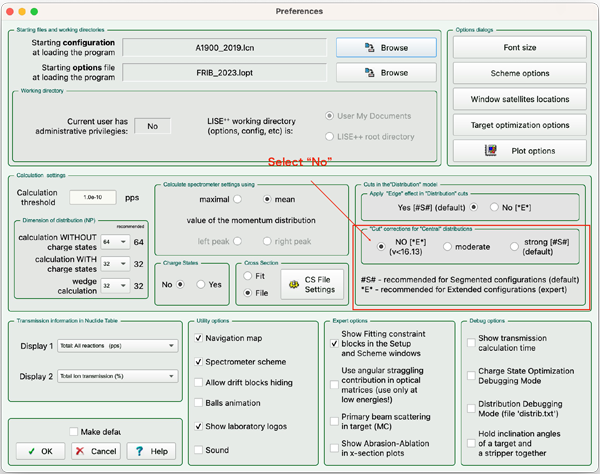
- Ensure that the specified option is selected in the LISE++ program (Fig.A):
-
Preferences —> “Cut” corrections for “Central” distributions —> select “No”
In particular, the option “strong” can in some cases produce obviously incorrect results, as shown in Fig B.
-
Preferences —> “Cut” corrections for “Central” distributions —> select “No”
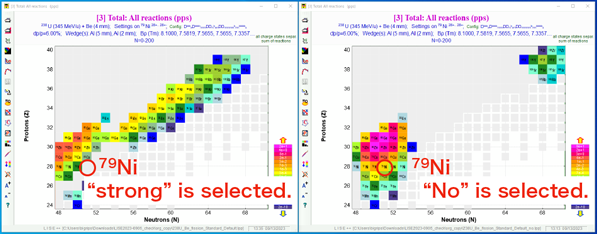
NOTE: If the primary beams in your experiment are not listed in the Table 1, please use the LISE++ files of B-6 and change the primary beam by yourself. In other LISE++ files, the measured cross sections, appropriate cross-section formula, and optimal detectors are already included. Input measured cross-sections are not deleted, even if you change the primary beams in the LISE++ files.
If you have any questions for the RI-beam production, please contact the BigRIPS team.
(The basic information about the beam line can be seen here)
Table 1. LISE++ input files.
BigRIPS+ZeroDegree |
BigRIPS+SAMURAI |
||
| A) In-flight-fission | 238U+Be (2024/Apr./1) | Download (lpp file) | Download (lpp file) |
| B) Fragmentation | B-1) 124Xe+Be (2024/Apr./1) | Download (lpp file) | Download (lpp file) |
| B-2) 78Kr+Be (2024/Apr./1) | Download (lpp file) | Download (lpp file) | |
| B-3) 70Zn+Be (2024/Apr./1) | Download (lpp file) | Download (lpp file) | |
| B-4) 48Ca+Be (2024/Apr./1) | Download (lpp file) | Download (lpp file) | |
| B-5) 18O+Be (2024/Apr./1) | Download (lpp file) | Download (lpp file) | |
| B-6) other (2024/Apr./1) | Download (lpp file) | Download (lpp file) |
Additional instruction:
(1) Select the input files for the reaction (A, B-1, …, B-6)
Please use the latest version of LISE++, if possible.
For BigRIPS or F8 experiments, please choose the LISE++ files of BigRIPS+ZeroDegree and use them without any changes for the Faraday Cups.
For F11 experiments, please choose the LISE++ files of BigRIPS+ZeroDegree and remove “FaradayCup 4” at F7.
For SAMURAI experiments, please choose the LISE++ files of BigRIPS+SAMURAI and use them without any changes for the Faraday Cups.
For Oedo or R3 experiments, please choose the LISE++ files of BigRIPS+ZeroDegree and insert “FaradayCup 2” after F3.
In the coversheet of the proposal, “Total Beam Rates @ F3” must be described. They cannot exceed 107/s due to radiation regulation. Please check them by inserting “Faraday Cup2” after F3 in your LISE++ files:
- Click “Experimental Settings” in menu
- Select “Spectrometer Design” then you can see the window like below
- Check the “Enable” box of “FaradayCup 2”
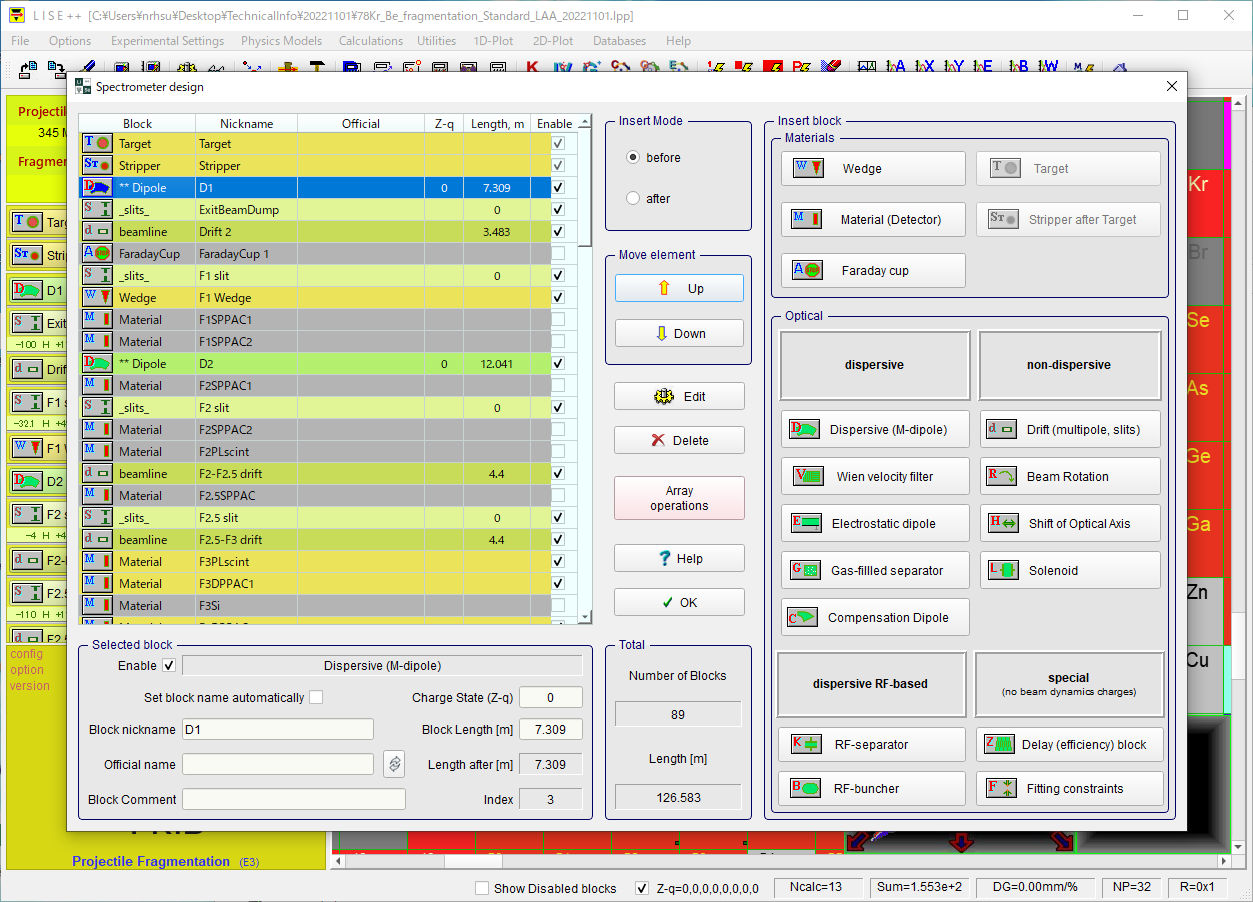
Fig. 0 Panel for inserting the Faraday Cups (click to Large Image)
(2) Notification in yield estimation using the LISE++ input files
a) For in-flight-fission 238U+Be
Please check the reaction mechanism to be set to Abrasion fission” as following:
- Click “Physics Models” in menu
- Select “Production Mechanism” then you can see the window like below:
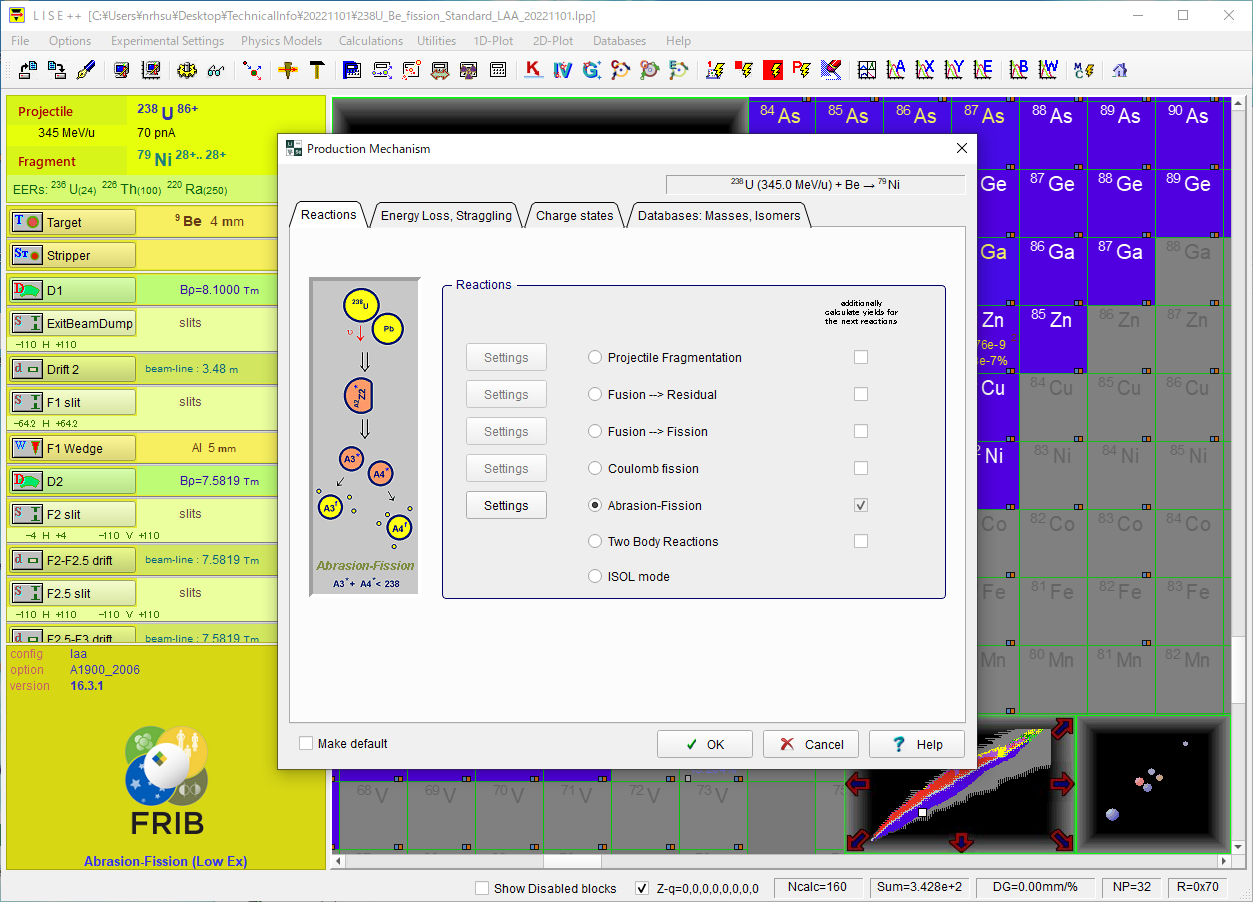
Fig. 1 Panel for reaction mechanism in 238U+Be
(click to Large Image)
This is just confirmation for unexpected changes of the setting parameters for reaction mechanism in LISE++.
Measured production cross sections of in-flight-fission 238U (345 A MeV)+Be are shown in Table 2. The data with errors are the weighted-averaged measured cross-sections, while the data without errors are calculated ones by LISE++ (ver. 8.4.1).
b) For fragmention
The yield calculation is based on the measured cross section in BigRIPS. The brown square (■) in each nuclide in the LISE++ panels shows that the measured cross section is already input for this nuclide. For other nuclei, the cross sections are calculated by the appropriate cross-section formula of each reaction. The appropriate cross-section formulae (EPAX3.1a [17] or EPAX2.15 [18]) are already chosen in each file, according to the primary beam. For the production of proton-rich nuclei from the 124Xe and 78Kr beams, the parameter which controls the low momentum tails is adjusted based on the measurement [9] in the BigRIPS. If the primary beams in your experiment are not listed in Table 1, please choose the LISE++ files of B-6 and change the primary beam by yourself. There is no measured cross-sections are included.
(3) Determine the position of the beam dump and input in the LISE++ file
You have to set the beam dump appropriately if the Brho value of the first dipole (D1) is close to that of a primary beam after a production target at the level of the BigRIPS momentum acceptance (+/-3%). Otherwise the calculated yields will overestimate the actual yields by factor of 2 or more.
Beam-Dump Calculator (Instruction manual is included in this site.)
References
[1] O.B. Tarasov and D. Bazin, Nucl. Phys. A 746 (2004) 411C
[2] T. Ohnishi et al., Journal of the Physical Society of Japan 77 (2008) 083201
[3] T. Ohnishi et al., Journal of the Physical Society of Japan 79 (2010) 073201
[4] T. Sumikama et al., Phys. Rev. C 95 (2017) 051601
[5] N. Fukuda et al., Journal of the Physical Society of Japan 87 (2018) 014202
[6] Y. Shimizu et al., Journal of the Physical Society of Japan 87 (2018) 014203
[7] T. Sumikama et al., Phys. Rev. C 103, (2021) 014614
[8] Y. Shimizu et al., Phys. Rev. C 109 (2024) 044313
[9] H. Suzuki et al., Nucl. Instr. and Meth. in Phys. B 317 (2013) 756
[10] I. Čeliković et al., Phys. Rev. Lett. 116 (2016) 162501
[11] H. Suzuki et al., Phys. Rev. C 96 (2017) 034604
[12] H. Suzuki et al., Phys. Rev. Lett. 119 (2017) 192503 and its supplementary material
[13] B. Blank et al., Phys. Rev. C 93 (2016) 061301(R)
[14] A. Kubiela et al., Phys. Rev. C 104 (2021) 064610
[15] D.S. Ahn et al., Phys. Rev. Lett. 123 (2019) 212501
[16] D.S. Ahn et al., Phys. Rev. Lett. 129 (2022) 212502
[17] K. Sümmerer, Phys. Rev. C 86 (2012) 014601
[18] K. Sümmerer and B. Blank, Phys. Rev. C 61 (2000) 034607
Production cross sections for the in-flight-fission 238U+Be at 345 A MeV (2024/Apr./1)
Neutron-rich isotopes have been produced since 2007 using the in-flight fission of 238U+Be at 345 A MeV [1-7]. The measured cross sections of Ca to Er with many experimental conditions are shown in Fig. 2 together with the calculated values by the abrasion fission model in the LISE++ (ver. 8.4.1) [8]. The derivation of experimental cross-sections are written here. The evaluated cross sections for the LISE++ are summarized in Table 2 and Fig. 3. For the nuclei whose cross sections were measured more than once, the weighted averages of the measured cross sections are adopted as the evaluated cross sections. Note that the errors of cross-sections for 66V,76Fe, 81,82Ni, 87Zn, 106Rb, 111Y, 114Zr, 117Nb, 119Mo, 122Tc, 128Rh, 131Pd, 150Xe, and 168Sm are large, because they were observed 1 event each in single cross-section measurements. Especially, the cross section of 82Ni looks larger than the systematics of less neutron-rich nuclei as shown in Fig. 3. So please be careful, if this nuclide is included in your objective RIs. The cross sections of 68,69Cr are not measured yet, and the evaluated cross sections of them were estimated by interpolation of the measured cross sections of the Cr isotopes. For other nuclei whose cross sections were not measured yet, the calculated cross sections by the LISE++ (ver. 8.4.1) are used. The discrepancy between the measured cross sections and the calculated ones increases with the atomic number in Z > 50 region. In Z > 60 region, the measured ones are ~103 times larger than the calculated ones. In reality, you may obtain more yields of your objective nuclei as well as neighboring nuclei than the calculation, resulting in over/under-estimate of purities. If you propose an experiment with Z > 55 RI beams, please contact the BigRIPS team.
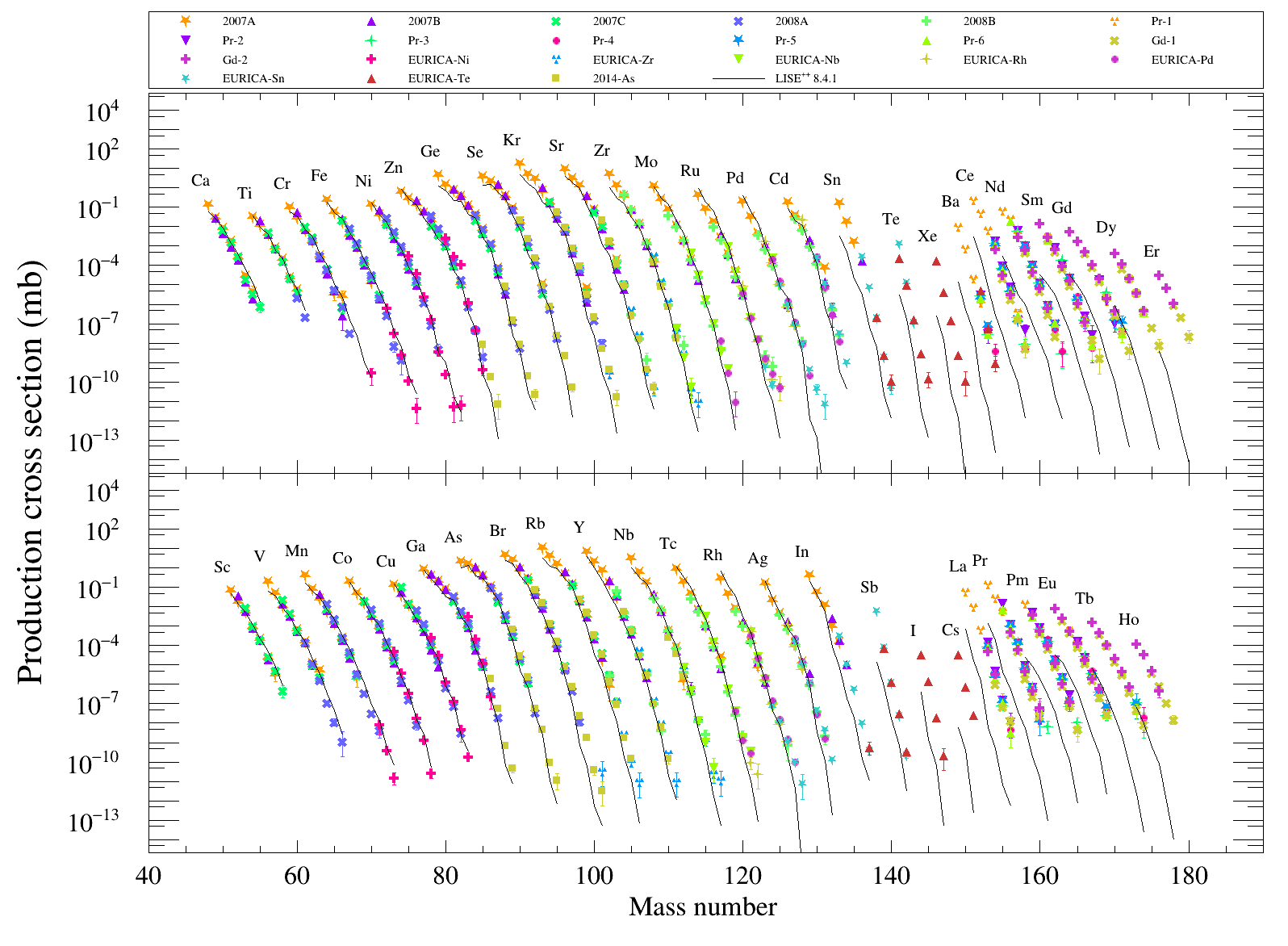
Fig. 2
Production cross sections in the in-flight fission of 238U+Be reaction at 345 A MeV together with the calculated cross sections by three-excitation model in the LISE++ (ver. 8.4.1). Each setting is described in the following references. 2007A [1], 2007B [1], 2007C [1], 2008A [2], 2008B [2], Pr-1 [4], Pr-2 [4], Pr-3 [4], Pr-4 [4], Pr-5 [4], Pr-6 [4], Gd-1 [4], Gd-2 [4], EURICA-Ni [3], EURICA-Zr [6], EURICA-Nb [5], EURICA-Rh [5], EURICA-Pd [5], EURICA-Sn [5], EURICA-Te[5], and 2014-As [7].
Table 2
Evaluated cross-section data of 238U+Be for the LISE++.

Fig. 3
Nuclei with measured cross sections in 238U+Be.
Blue; measured cross sections. Yellow; estimated cross sections by interpolation of adjacent nuclei. Green; calculated cross sections with the LISE++ (ver. 8.4.1).
References
[1] T. Ohnishi et al., Journal of the Physical Society of Japan 77 (2008) 083201
[2] T. Ohnishi et al., Journal of the Physical Society of Japan 79 (2010) 073201
[3] T. Sumikama et al., Phys. Rev. C 95 (2017) 051601
[4] N. Fukuda et al., Journal of the Physical Society of Japan 87 (2018) 014202
[5] Y. Shimizu et al., Journal of the Physical Society of Japan 87 (2018) 014203
[6] T. Sumikama et al., Phys. Rev. C 103, (2021) 014614
[7] Y. Shimizu et al., Phys. Rev. C 109 (2024) 044313
[8] O.B. Tarasov and D. Bazin, Nucl. Phys. A 746 (2004) 411C
Production cross sections for the 124Xe+Be reaction at 345 A MeV (2019/Jul./5)
Proton-rich isotopes have been produced since 2011 using the 124Xe+Be reaction at 345 A MeV [1-4]. The measured cross sections of Kr to Te with several experimental conditions are shown in Fig. 4 together with the calculated cross section by EPAX3.1a [5], which reproduce the cross sections better than other formula such as EPAX2.15 [6] in this reaction. The evaluated cross sections for the LISE++ [7] are summarized in Table 3 and Fig. 5. For the nuclei whose cross sections were measured more than once, the data with larger transmission were chosen as the evaluated cross sections. Note that the errors of cross sections for 69Kr, 77Zr, 81Mo, 85Ru, and 89Rh are large, because they were observed 1 event each in single cross-section measurements. The cross sections of 73Kr, 77Y, 78Zr, 90Tc, and 91Pd are not measured yet, thus the evaluated cross sections of them were estimated by interpolation of the measured cross sections of their isotopic or isotonic chains. The discrepancy between the evaluated cross sections and the EPAX3.1a calculations is relatively small in this reaction. However, the EPAX3.1a calculations overestimate the cross sections near the proton drip-line or Z > 50 region. If you propose an experiment with RI beams near the proton drip-line or Z > 50 region, please contact the BigRIPS team.
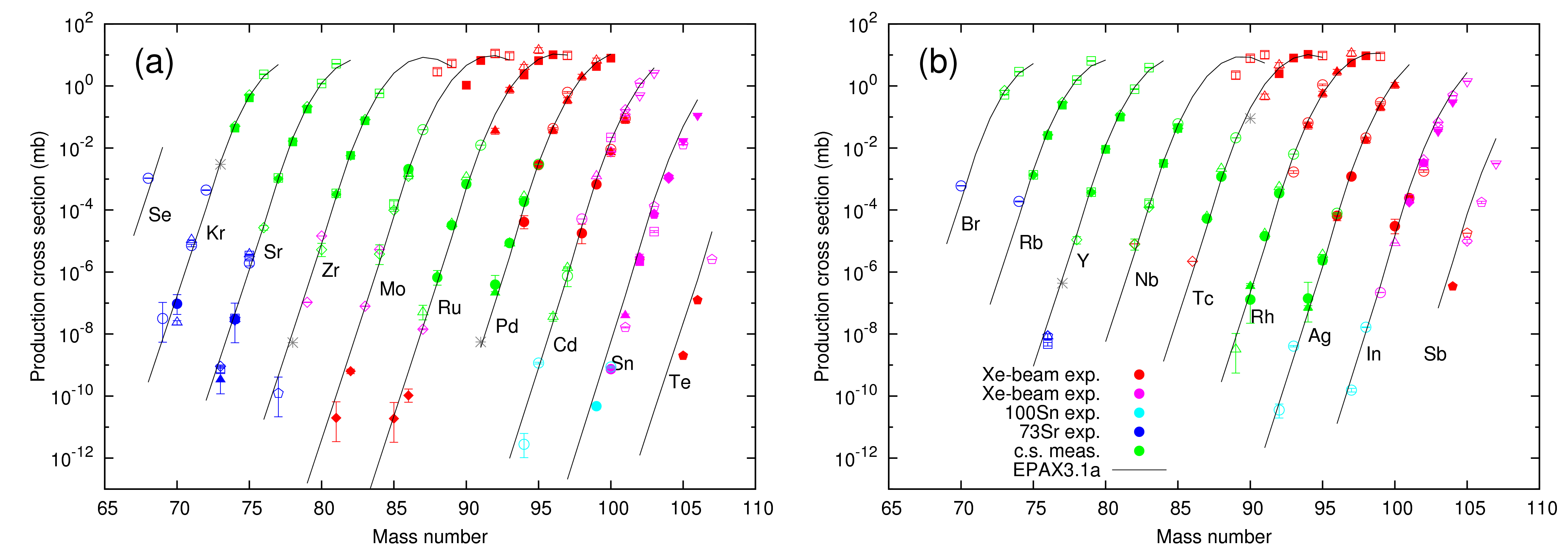
Fig. 4
Production cross sections in the 124Xe+Be reaction at 345 A MeV together with the calculated cross sections by EPAX3.1a [5]. Each setting is described in the following references. Xe-beam exp. [1,3], 100Sn exp. [2], 73Sr exp. [4], and c.s. meas. [4]. The filled symbols indicate that the distribution peak is located inside the slit opening at each focus (transmission > ~50%) and the open symbols indicate that it is located outside at some foci (~50% > transmission > ~10%).
Table 3
Evaluated cross-section data of 124Xe+Be for the LISE++.
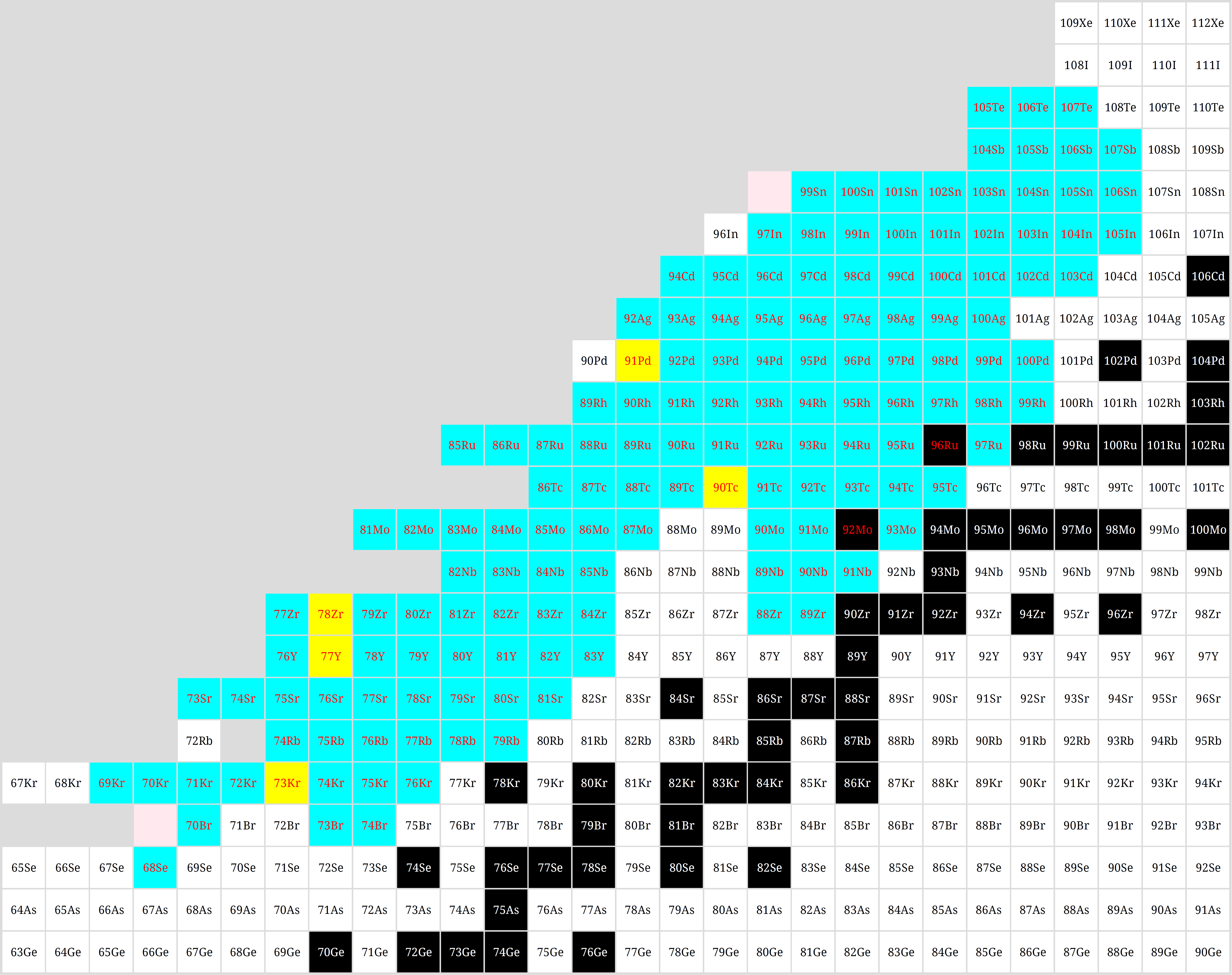
Fig. 5
Nuclei with evaluated cross sections in 124Xe+Be.
Blue; measured cross sections. Yellow; estimated cross sections by interpolation of adjacent nuclei
References
[1] H. Suzuki et al., Nucl. Instr. and Meth. in Phys. B 317 (2013) 756
[2] I. Čeliković et al., Phys. Rev. Lett. 116 (2016) 162501
[3] H. Suzuki et al., Phys. Rev. C 96 (2017) 034604
[4] H. Suzuki et al., Phys. Rev. Lett. 119 (2017) 192503 and its supplementary material
[5] K. Sümmerer, Phys. Rev. C 86 (2012) 014601
[6] K. Sümmerer and B. Blank, Phys. Rev. C 61 (2000) 034607
[7] Y. Shimizu et al., Phys. Rev. C 109 (2024) 044313
[8] O.B. Tarasov and D. Bazin, Nucl. Phys. A 746 (2004) 411C
Production cross sections for the 78Kr+Be reaction at 345 A MeV (2024/Apr./1)
Proton-rich isotopes have been produced since 2015 using the 78Kr+Be reaction at 345 A MeV [1,2]. The measured cross sections of Ti to Kr with several experimental conditions are shown in Fig. 6 together with the calculated values by EPAX3.1a [3], which reproduce the cross sections better than other formula such as EPAX2.15 [4] in this reaction. The evaluated cross sections for the LISE++ [5] are summarized in Table 4 and Fig. 7. Note that the error of cross section for 39Ti is large, because it was observed 1 event. The EPAX3.1a calculations overestimate the cross sections near the proton drip-line or Z > 32 region. If you propose an experiment with RI beams near the proton drip-line or Z > 32 region, please contact the BigRIPS team.
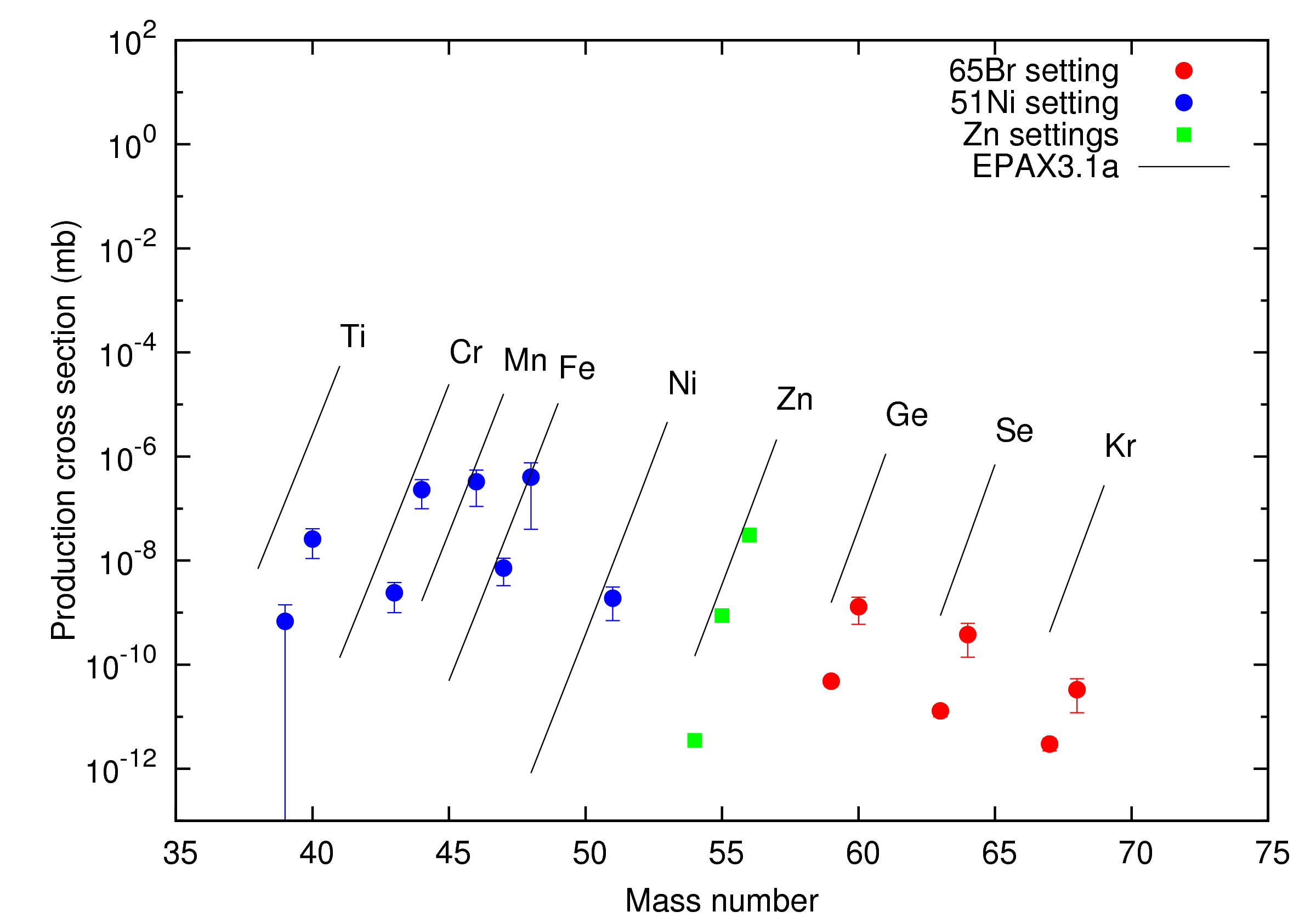
Fig. 6
Production cross sections in the 78Kr+Be reaction at 345 A MeV together with the calculated cross sections by EPAX3.1a [3]. Each setting is described in the following references. 65Br setting [1], 51Ni setting [1], and Zn settings [2].
Table 4
Evaluated cross-section data of 78Kr+Be for the LISE++.
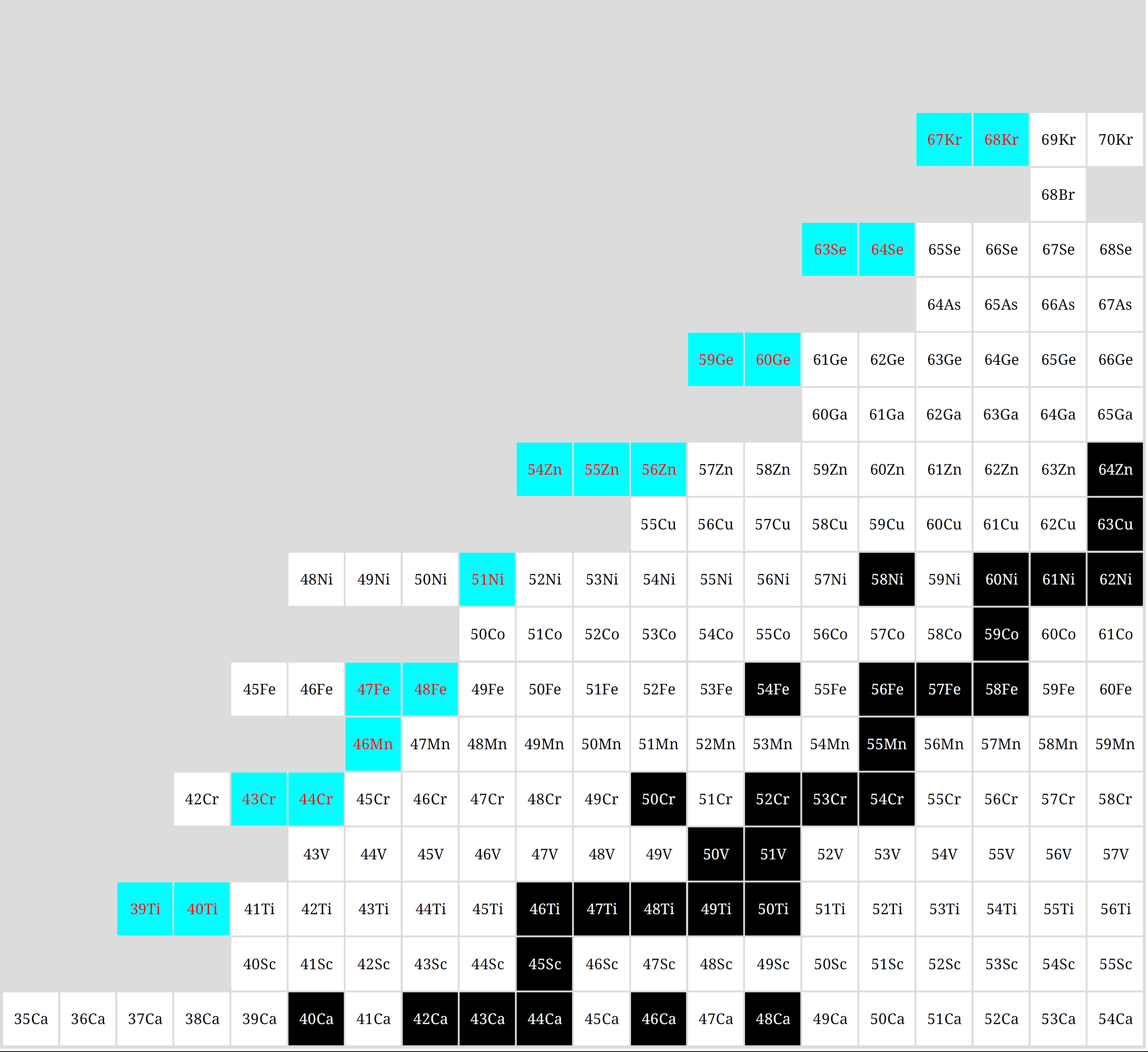
Fig. 7
Nuclei with evaluated cross sections in 78Kr+Be.
References
[1] B. Blank et al., Phys. Rev. C 93 (2016) 061301(R)
[2] A. Kubiela et al., Phys. Rev. C 104 (2021) 064610
[3] K. Sümmerer, Phys. Rev. C 86 (2012) 014601
[4] K. Sümmerer and B. Blank, Phys. Rev. C 61 (2000) 034607
[5] O.B. Tarasov and D. Bazin, Nucl. Phys. A 746 (2004) 411C
Production cross sections for the 70Zn+Be reaction at 345 A MeV (2018/Jul./1)
Neutron-rich isotopes have been produced since 2013 using the 70Zn+Be reaction at 345 A MeV. The cross section formula of EPAX3.1a [1] is chosen in the LISE++ [2] file, because it reproduce the experimental cross sections fairly well.
References
[1] K. Sümmerer, Phys. Rev. C 86 (2012) 014601
[2] O.B. Tarasov and D. Bazin, Nucl. Phys. A 746 (2004) 411C
Production cross sections for the 48Ca+Be reaction at 345 A MeV (2022/Nov./1)
Neutron-rich isotopes have been produced since 2008 using the 48Ca+Be reaction at 345 A MeV [1-3]. The measured cross sections of B to S with several experimental conditions are shown in Fig. 8 together with the calculated values by EPAX2.15 [4], which reproduce the cross sections better than other formula such as EPAX3.1a [5] in this reaction. The evaluated cross sections for the LISE++ [6] are summarized in Table 5 and Fig. 9. For the nuclei whose cross sections were measured more than once, the data with larger transmission or newer data if they have similar transmissions were chosen for the evaluated cross sections. Note that the measured cross sections may include the secondary-reaction effects in the production targets. By the LISE++, this effect makes cross sections a few times larger at very neutron-rich region when using 15-20 mm Be targets [1]. Please be careful when you have a plan to use thin targets, because this effect should be close to 1.
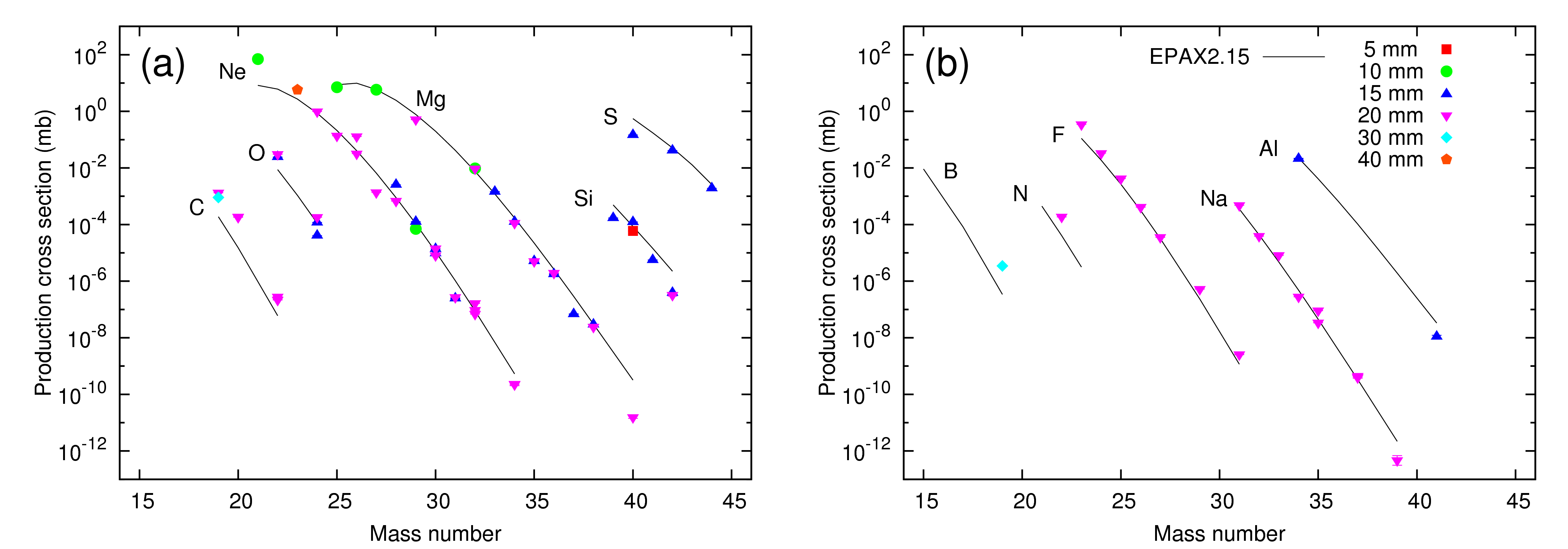
Fig. 8
Production cross sections in the 48Ca+Be reaction at 345 A MeV together with the calculated cross sections by EPAX2.15 [4]. In the BigRIPS settings for derivation of the cross sections, the objective nuclei or their isotones were set to be central particles.
The settings are described in the reference [1-3].
Table 5
Evaluated cross-section data of 48Ca+Be for the LISE++.
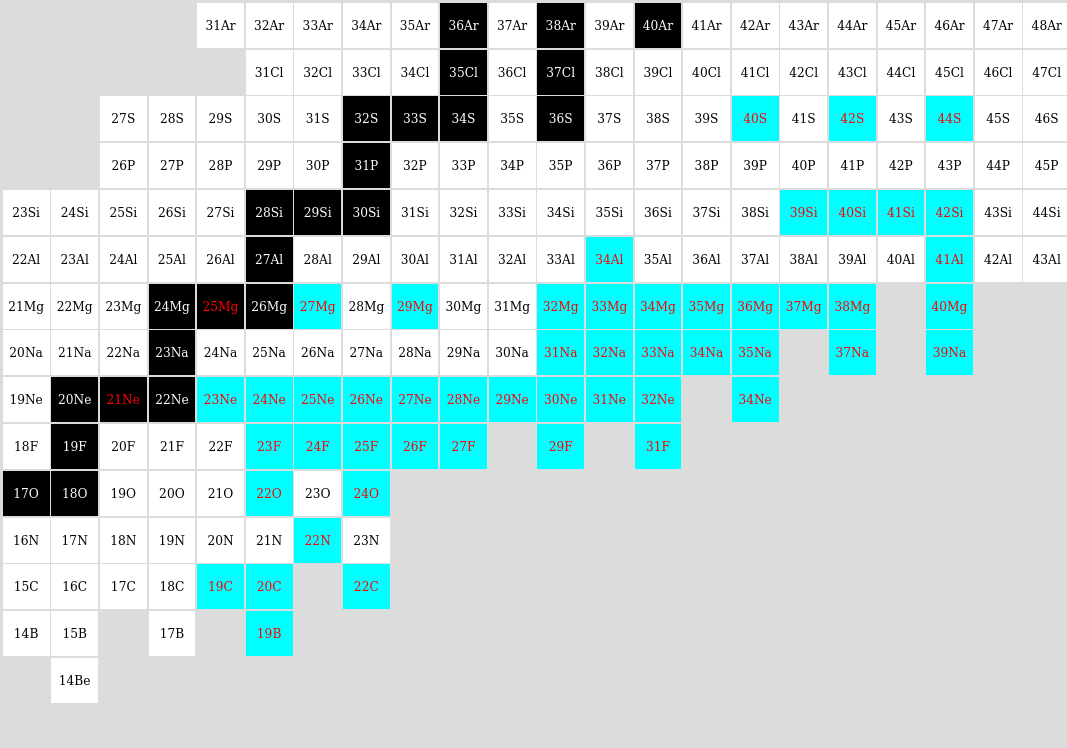
Fig. 9
Nuclei with evaluated cross sections in 48Ca+Be.
References
[1] H. Suzuki et al., Nucl. Instr. and Meth. in Phys. B 317 (2013) 756
[2] D.S. Ahn et al., Phys. Rev. Lett. 123 (2019) 212501
[3] D.S. Ahn et al., Phys. Rev. Lett. 129 (2022) 212502
[4] K. Sümmerer and B. Blank, Phys. Rev. C 61 (2000) 034607
[5] K. Sümmerer, Phys. Rev. C 86 (2012) 014601
[6] O.B. Tarasov and D. Bazin, Nucl. Phys. A 746 (2004) 411C
Production cross sections for the 18O+Be reaction at 230, 250, 294, and 345 A MeV (2018/Jul./1)
Neutron-rich and proton-rich isotopes have been produced since 2012 using the 18O+Be reaction at 230, 250, 294, and 345 A MeV. We assume that there is no energy dependence for the cross sections. The cross section formula of EPAX3.1a [1] is chosen in the LISE++ [2] file, because it reproduce the experimental cross sections fairly well. However, the EPAX3.1a calculations overestimate the cross sections in proton-rich Z > 3 region, especially at the proton drip-line. If you propose an experiment with RI beams in proton-rich Z > 3 region, please contact the BigRIPS team.
References
[1] K. Sümmerer, Phys. Rev. C 86 (2012) 014601
[2] O.B. Tarasov and D. Bazin, Nucl. Phys. A 746 (2004) 411C